

The Operating Reality
Today's Infrastructure Faces Pressure From Every Direction.
REALITYAs energy costs rise, electrification accelerates, and grid reliability becomes less predictable, organizations need more than additional capacity—they need resilient energy infrastructure designed for long-term performance. Your facility’s relationship with the grid was built for a world that no longer exists.
Rising Energy Costs
Grid Reliability
Electrification
Demand charges, time-of-use pricing, and volatile electricity markets continue to increase operating costs and reduce budget certainty.
Power interruptions and grid instability can disrupt operations, impact critical systems, and create costly downtime.
EV charging, facility expansion, and increasing electrical loads often exceed existing infrastructure, requiring costly utility upgrades.

The Radiance Solution
Battery Storage Built for the Future of Infrastructure.
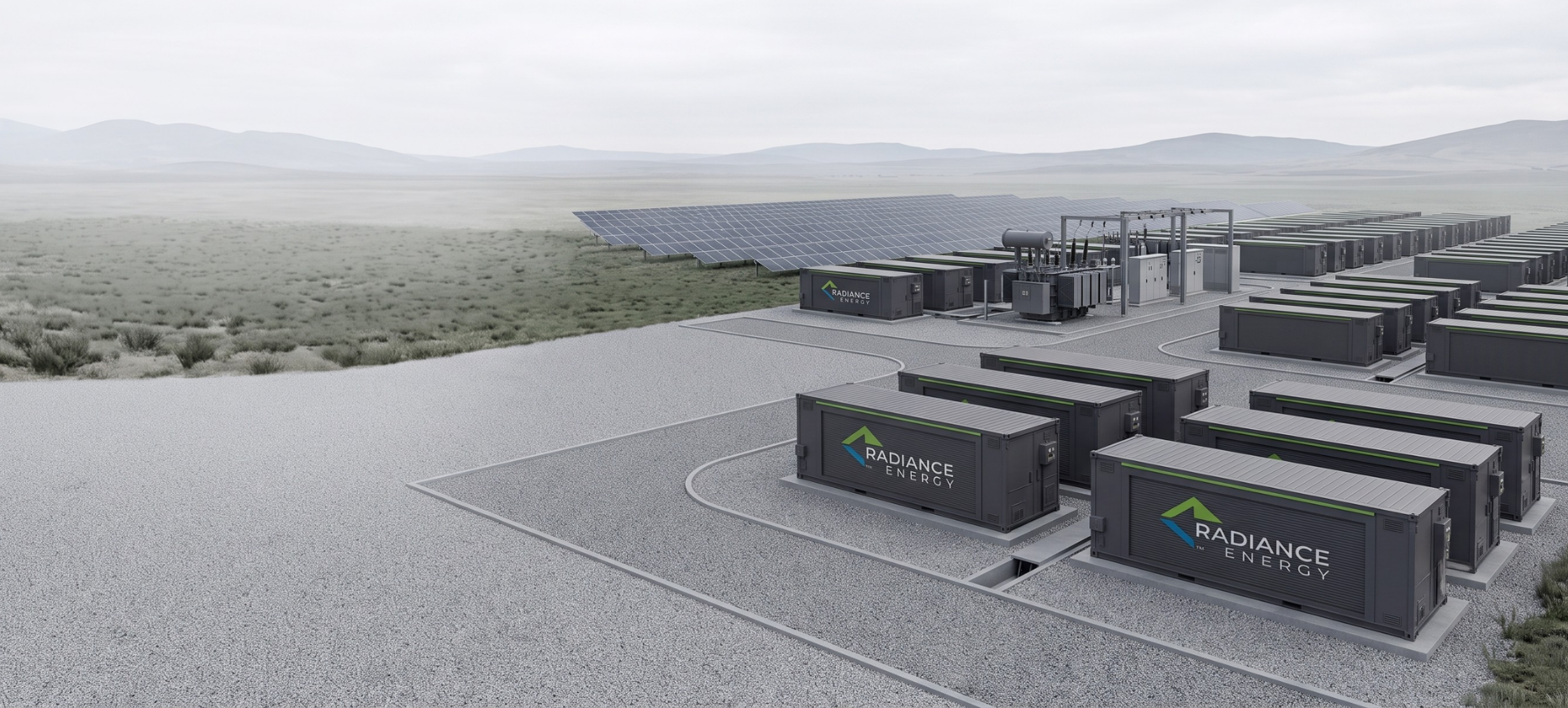
SolutionBattery Energy Storage Systems give organizations greater control over how and when energy is used. By intelligently storing and deploying electricity, businesses can reduce operating costs, improve resilience, support electrification, and build a more flexible energy infrastructure for the future.
Radiance designs and delivers complete Battery Energy Storage Systems tailored to each facility’s operational goals, electrical infrastructure, and long-term growth strategy.
Peak Demand Management
Reduce demand charges by intelligently shifting when electricity is drawn from the grid.
Energy Cost Optimization
Store energy when costs are lower and deploy it when demand and electricity prices are highest.
Energy Resilience
Maintain critical operations during grid disturbances and improve business continuity.
Renewable Energy Integration
Capture and utilize excess renewable generation to improve energy utilization and reduce reliance on the grid.
Electrification Readiness
Support EV charging, facility expansion, and increasing electrical loads without relying on costly utility upgrades.
Intelligent Energy Control
Monitor, manage, and optimize energy performance through advanced controls and real-time system intelligence.
Why Radiance
Built for Decades.
Designed for Critical Infrastructure.
Why us Most battery storage technologies require compromises between lifespan, safety, performance, and operating cost.
Radiance takes a different approach.
Through advanced nickel-hydrogen battery technology, our systems deliver exceptional safety, long operating life, and consistent performance with minimal degradation—reducing lifecycle costs while improving long-term reliability.
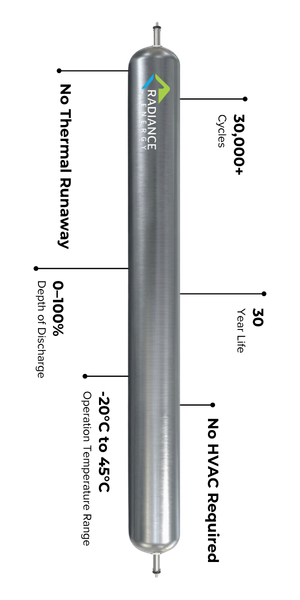
30+ Year Design Life
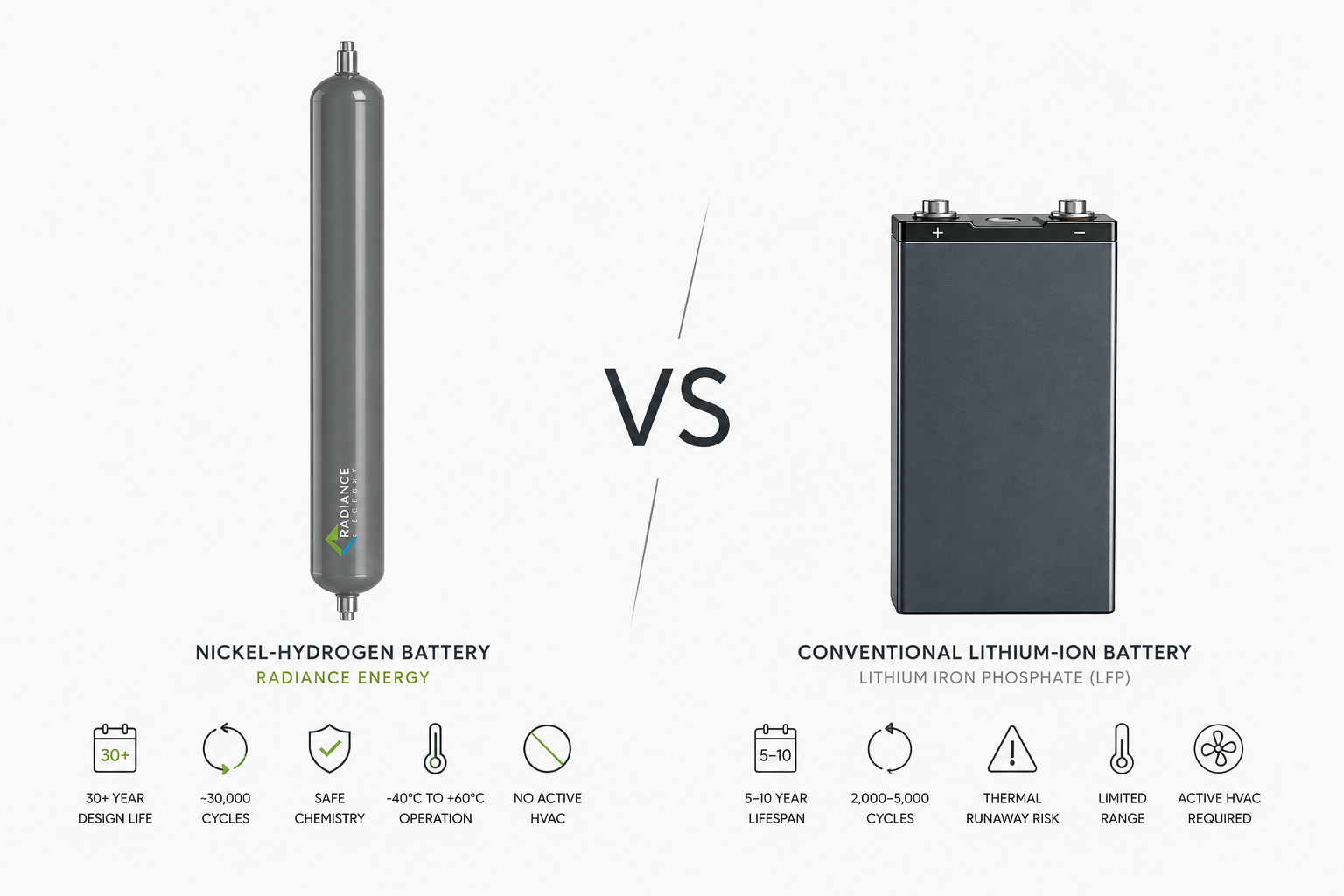
Unlike conventional battery technologies that often require replacement after 5–10 years, Radiance's nickel-hydrogen systems are engineered for more than three decades of continuous operation. The extended service life minimizes system replacements, reduces operational disruptions, and improves long-term infrastructure planning.
30,000 Charge Cycles
Designed to deliver approximately 30,000 charge and discharge cycles with minimal capacity loss, the system maintains predictable performance throughout its lifespan. This exceptional cycle life makes it well suited for daily energy shifting, peak demand management, and critical backup applications.
No Thermal Runaway Fire Risk
Nickel-hydrogen chemistry does not experience thermal runaway, significantly reducing fire risk compared to conventional battery technologies. This inherently safer design enhances operational reliability while reducing the need for complex safety infrastructure.
Minimal Degradation
Performance remains remarkably consistent over decades of operation, with minimal capacity degradation throughout the system's life. Organizations benefit from predictable energy availability without frequent augmentation or premature battery replacement.
Wide Operating Temperatures
Designed to deliver optimal performance between −20°C and +45°C, while remaining operational across temperatures from −40°C to +60°C. The system operates without active HVAC, eliminating the energy consumption, maintenance, and complexity associated with continuous heating and cooling systems while lowering overall operating costs.
100% Usable Capacity
The system supports up to 100% depth of discharge, allowing organizations to utilize virtually the entire stored energy capacity when needed. More usable energy means greater operational flexibility and improved return on every installed kilowatt-hour.
Category
Radiance Nickel-Hydrogen
Conventional Battery Technology
Design Life
30+ year design life
Typically 5–15 years
Cycle Life
Approximately 30,000+ cycles
Approximately 2,000–5,000 cycles
Depth of Discharge
100% usable capacity
Often limited to preserve battery life
Capacity Retention
Minimal degradation over operating life
Capacity declines over time
Thermal Runaway
No thermal runaway fire risk
Potential thermal runaway risk
Thermal Management
No active HVAC
Active HVAC required
Fire Suppression
Not required
Required
Capacity Augmentation
Not required
Often required
Operational Intervention
Low maintenance
Higher maintenance requirements
Recyclability
98%+ recyclable materials
Limited material recovery
Lifecycle Value
Lower lifecycle cost
Higher lifecycle cost
The Business Advantage
Where Conventional Batteries Reach Their Limits
ADVANTAGESome applications place unique demands on energy storage. These are the environments where Nickel-Hydrogen delivers meaningful advantages in safety, reliability, lifecycle performance, and long-term operational value.
Indoor Placement
Nickel-hydrogen batteries can be installed in locations where fire safety, occupant protection, and permitting requirements are a priority.
Fire-Risk Sensitive Locations
Ideal for facilities where safety and operational continuity are critical, including schools, hospitals, offices, and public buildings.
Multiple Daily Cycles
Designed for frequent charging and discharging, with 30,000+ cycles and long-term performance.
No Room for Future Expansion
Maintains long-term capacity without requiring additional battery cabinets or future augmentation.
Cold Climate Performance
Operates reliably in low-temperature environments without extensive thermal management systems.
Hot Climate Performance
Delivers consistent performance in high temperatures while reducing cooling requirements.
Insurance-Sensitive Projects
Helps address concerns related to fire exposure, operational risk, and long-term asset protection.
Sustainability & Recyclability
Highly recyclable and designed for decades of service, reducing waste and replacement frequency.
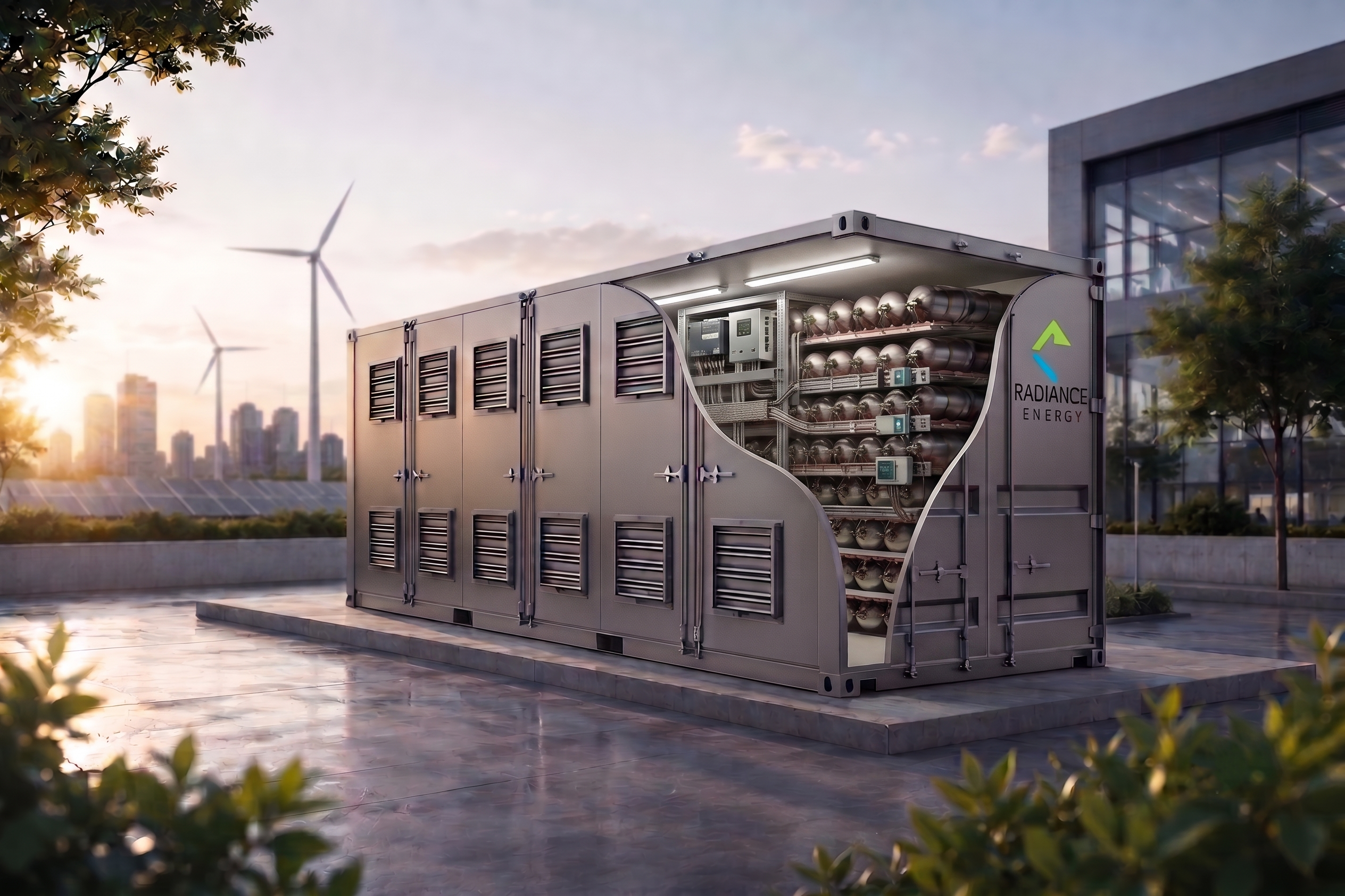
Indoor Placement
Non-combustible chemistry simplifies indoor deployment.
Fire-Risk-Sensitive Applications
Designed for environments where safety is paramount. Hospitals, airports, ports can’t risk it
Hot Climate Extremes
No active cooling infrastructure required.
Recyclable Materials
98%+ recyclable, supports sustainability goals and responsible end-of-life management.
Multiple Daily Cycles
Approximately 30,000 cycles with minimal degradation.
Augmentation Not Practical
When there is no room on-site to add capacity in the future.
Cold Climate Extremes
Reliable operation without active HVAC.
Insurance-Sensitive Projects
Supports projects where fire risk influences insurance requirements.
how we work
Engineering Delivery Process
StepsFrom initial assessment to long-term support, Radiance manages every stage of battery energy storage deployment. Our integrated approach ensures each system is engineered around the site, operational requirements, and long-term energy objectives.
01
step
Discovery
We evaluate your facility, energy profile, and operational objectives to define the optimal storage strategy, ensuring every project begins with confidence.
04
step
Installation
Our specialists coordinate construction, electrical integration, equipment installation, and site preparation, delivering efficient execution with minimal operational disruption throughout projects.
02
step
Engineering
Our engineers design complete electrical systems, equipment layouts, and control strategies, delivering reliable solutions tailored to long-term operational performance.
05
step
Commissioning
Every system undergoes comprehensive testing, validation, and performance verification, ensuring safe operation, reliable functionality, and seamless integration before commissioning.
03
step
Procurement
Radiance sources batteries, power conversion equipment, electrical components, and supporting infrastructure, ensuring every system meets strict performance standards.
06
step
Lifecycle Support
Radiance provides continuous monitoring, technical support, maintenance coordination, and performance optimization, maximizing long-term operational value for every installation.
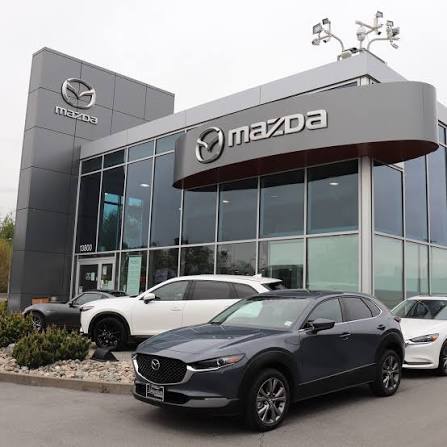
First in Canada
Proven in the Field
VerifiedCanada’s first BC Hydro-approved Nickel-Hydrogen Battery Energy Storage deployment demonstrates how advanced energy storage can support electrification, improve operational resilience, and create long-term infrastructure value. Working with Signature Mazda, Radiance Energy designed and delivered a future-ready energy platform that supports EV charging growth while leveraging the unique advantages of Nickel-Hydrogen technology—including a 30+ year design life, approximately 30,000 charge cycles, no thermal runaway risk, and minimal capacity degradation. The project stands as a real-world example of how organizations can prepare for increasing energy demands without compromising safety, reliability, or long-term performance.
FAQ
Frequently Asked Questions
What is a Battery Energy Storage System (BESS)?
A Battery Energy Storage System stores electricity for use when it is needed most. By intelligently charging and discharging energy, BESS helps organizations reduce peak demand charges, improve energy resilience, support electrification initiatives, and optimize overall energy performance.
What makes Nickel-Hydrogen different from conventional battery technologies?
Nickel-Hydrogen batteries offer a unique combination of safety, longevity, and reliability. Unlike conventional battery technologies, Nickel-Hydrogen systems deliver approximately 30,000 charge cycles, a 30+ year design life, minimal degradation, and no thermal runaway risk, making them well suited for long-term infrastructure applications.
Is active HVAC required?
No. Nickel-Hydrogen technology operates without requiring active HVAC systems for safe operation. Eliminating dedicated cooling infrastructure can simplify installation, reduce operating costs, and improve overall system reliability.
Is fire suppression required?
Nickel-Hydrogen batteries do not experience thermal runaway and do not require dedicated fire suppression systems. This can simplify deployment in applications where safety and risk management are critical considerations.
Can battery storage support EV charging infrastructure?
Yes. Battery Energy Storage can help support EV charging by reducing peak electrical demand, managing charging loads, and minimizing the need for costly utility infrastructure upgrades. This is particularly valuable for commercial properties, fleets, dealerships, and public charging locations.
Can battery storage reduce electricity costs?
Yes. By storing energy when demand is low and deploying it when demand and electricity costs are highest, Battery Energy Storage can help reduce peak demand charges and improve overall energy cost management.
Can Radiance design a system for my facility?
Absolutely. Every project begins with a detailed assessment of your facility, energy profile, operational requirements, and future growth plans. Radiance designs and delivers tailored Battery Energy Storage solutions aligned with each organization’s long-term objectives.
What incentives are available for Battery Energy Storage?
Available incentives vary by utility, jurisdiction, and project type. Radiance works with clients throughout the evaluation process to identify applicable incentive programs and maximize available funding opportunities.